MIG Welding Course in Multan
Practical MIG / GMAW Welding Training for Technical Skill Development. Master semi-automatic wire-feed welding, shielding gas regulation, voltage tuning, and plate and pipe joint welding at Ashtar Trade Test & Technical Training Centre in Multan.
Supervised Workshop Practice
MIG / GMAW Wire Feeder Setup & Positional Joint Welding
Master Practical MIG / GMAW Welding Skills in Multan
Metal Inert Gas (MIG) welding, technically classified under AWS standards as GMAW (Gas Metal Arc Welding) and widely referred to in industrial workshops as wire-feed or CO2 welding, is one of the most efficient semi-automatic welding processes in modern manufacturing and construction. Unlike manual stick welding where electrodes must be replaced frequently, MIG welding feeds a continuous solid wire electrode from a motor-driven spool through a flexible conduit into the welding gun handle.
Enrolling in a dedicated MIG Welding Course in Multan enables trainees to build practical competence in balancing machine voltage, wire feed speed (WFS), drive roll tension, and shielding gas flow rates. Because MIG welding delivers high metal deposition rates and minimal slag cleanup, it is heavily used across structural steel fabrication shops, heavy machinery assembly lines, automotive repair facilities, and industrial manufacturing plants across Pakistan and overseas.
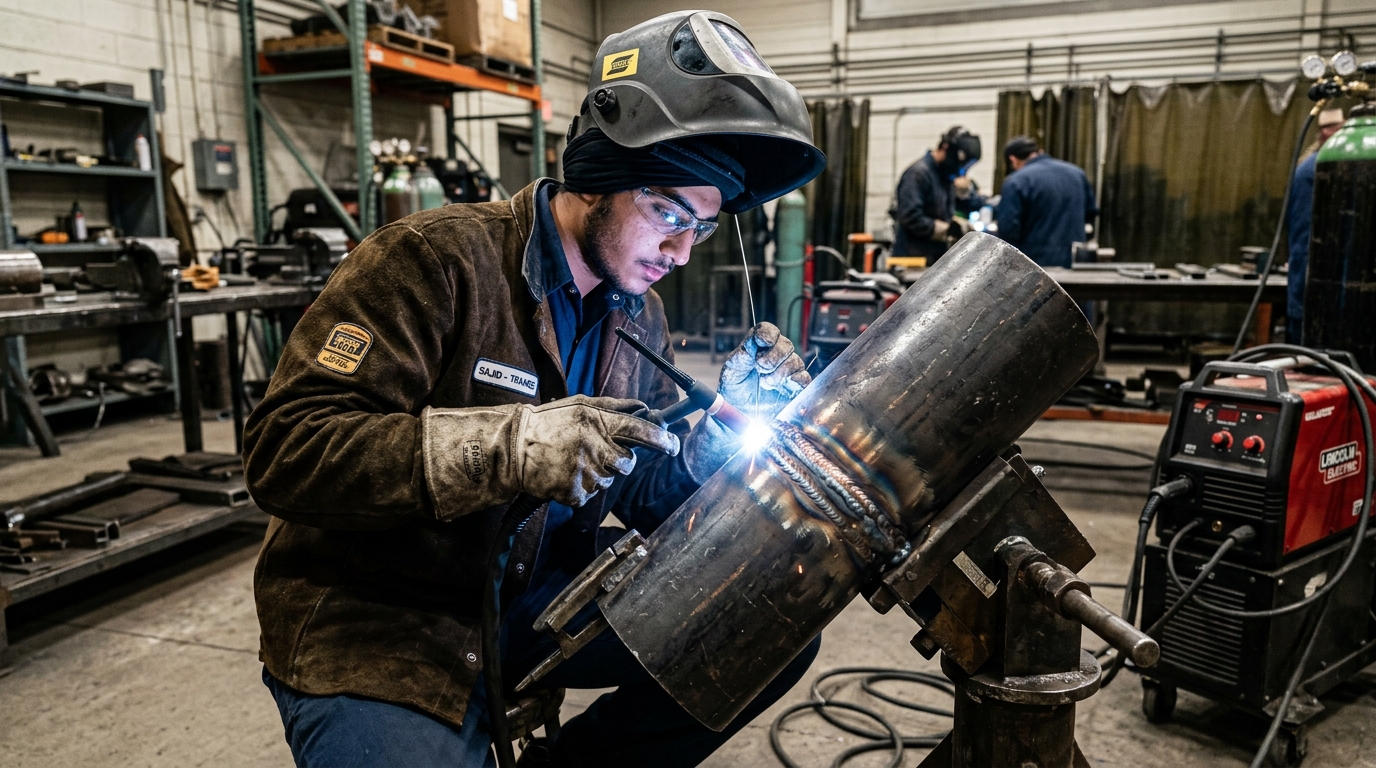
At Ashtar Trade Test & Technical Training Centre, practical workshop practice is the core foundation of training. Trainees practice in dedicated welding booths equipped with industrial MIG power sources, wire feeder units, shielding gas flow meters, and beveling machinery. Under the supervision of experienced technical instructors, students practice flat, horizontal, vertical, and overhead joint configurations on carbon steel plates and pipe sections, developing the travel speed consistency, arc puddle control, and workshop safety discipline required for trade test evaluations.
What Is MIG Welding?
An educational overview of Gas Metal Arc Welding (GMAW / MIG) principles, equipment, and characteristics.
MIG Welding stands for Metal Inert Gas welding, officially designated as GMAW (Gas Metal Arc Welding) in technical standards.
In the MIG process, an electric arc is established between a continuously fed, consumable solid wire electrode and the metal workpiece. As the trigger on the welding gun is pulled, the wire feeder advances wire at a set speed while shielding gas (such as pure CO2 or an Argon/CO2 mixture) flows out of the gun nozzle to protect the arc and molten weld pool from atmospheric oxidation.
Because the wire consumable is fed automatically, the welder can focus on torch angle, nozzle-to-work distance (stick-out), and travel speed. This semi-automatic mechanism allows for continuous bead deposition without frequent electrode changes, making MIG welding ideal for structural steel plates, structural frames, and heavy fabrication.
MIG, GMAW and CO2 Welding — What's the Difference?
In industrial workshops and vocational training conversations, terms like MIG welding, GMAW, and CO2 welding are frequently used interchangeably. Understanding the subtle distinction helps trainees communicate effectively with engineering specifications and recruitment evaluators:
1. MIG (Common Name)
MIG (Metal Inert Gas) is the widely recognized commercial and workshop term used by fabricators, welders, and technicians.
2. GMAW (Technical Process)
GMAW (Gas Metal Arc Welding) is the official technical process designation defined under American Welding Society (AWS) standards.
3. CO2 Welding (Shielding Gas)
CO2 welding refers specifically to GMAW applications using 100% carbon dioxide shielding gas for economical carbon steel fabrication.
MIG vs TIG vs ARC Welding
Comparison of key industrial welding processes to understand their respective technical roles.
| Process Name | Common Name | General Characteristics | Typical Training Focus |
|---|---|---|---|
| MIG / GMAW | MIG Welding / Wire Feed / CO2 | Continuous solid wire spool, semi-automatic feeder, high deposition speed, gas shielding (CO2 or Argon/CO2). | Structural fabrication, manufacturing, plate joints, automotive frames. |
| TIG / GTAW | Argon Welding / TIG | Non-consumable tungsten, pure argon gas, two-handed coordination, zero slag, precision keyhole root penetration. | High-pressure pipe roots, stainless steel, alloy tubing, precision components. |
| ARC / SMAW | Stick Welding / Electric Arc | Flux-coated consumable stick electrode, protective slag layer, highly portable for outdoor field construction. | Heavy structural steel, site repairs, outdoor pipeline capping. |
Note: Different welding processes serve different industrial applications. Many advanced welders build multi-process skills to increase technical versatility.
What You Learn in MIG Welding Training
Key practical training areas covered across workshop modules at Ashtar Trade Test Center Multan.
1. Wire Feeder Setup & Tension Control
Installing wire spools (ER70S-6), setting drive roll groove size, adjusting wire tension, and threading wire through the liner.
2. Machine Voltage & WFS Balancing
Tuning arc voltage and wire feed speed (WFS) ratios to achieve smooth short-circuit transfer and steady arc crackle.
3. Shielding Gas Regulation & Flowmeters
Adjusting CO2 and Argon/CO2 mixture flow rates (L/min), checking gas cylinder pressure, and nozzle diffuser cleaning.
4. Torch Angle & Stick-Out Discipline
Mastering push vs. pull torch techniques, contact tip to work distance (CTWD / stick-out), and travel angle manipulation.
5. Carbon Steel Plate Beveling & Fitting
Preparing bevel angles on carbon steel plates, root face land preparation, tack welding, and joint alignment clamping.
6. Positional Plate Welding (1G–4G)
Progressive joint welding practice across 1G flat groove, 2G horizontal, 3G vertical-up/down, and 4G overhead plate positions.
7. Pipe Joint Fitting & MIG Root Practice
Understanding pipe fit-up, root gap maintenance under shrinkage, and MIG root/fill pass execution on structural pipe spools.
8. Visual Inspection & Defect Prevention
Evaluating bead symmetry, drop-through, cap reinforcement, preventing cold lap, porosity, undercut, and excessive spatter.
9. Workshop Safety & PPE Discipline
Auto-darkening helmet shade selection, leather welding jackets, heavy gloves, ventilation safety, and power tool operation.
Practical MIG Welding Training in Multan
At Ashtar Trade Test & Technical Training Centre, practical workshop training forms the cornerstone of skill development. We believe that true welding proficiency cannot be acquired solely through classroom lectures; it requires continuous, supervised practice inside dedicated workshop bays.
Trainees at our Multan center work directly with industrial MIG welding power sources, wire drive mechanisms, and shielding gas cylinders. Under instructor guidance, candidates practice wire spool loading, drive roll adjustment, contact tip replacement, joint edge beveling, and multi-pass bead deposition on carbon steel plates and structural pipe sections.
MIG Pipe Welding Training
While MIG welding is heavily associated with plate fabrication, it is also increasingly utilized for industrial pipe spool fabrication and root/fill pass welding in modern manufacturing facilities.
Trainees practicing MIG pipe welding learn bevel edge alignment, root gap fit-up, bridge tacking, and managing short-circuit wire transfer around curved pipe contours. Instructors guide students on controlling heat input to avoid burn-through while ensuring complete root fusion and clean fill passes.
MIG Plate Welding Practice
Plate welding forms the fundamental training base for all MIG welders. Trainees begin by depositing straight stringer beads and weave patterns on flat carbon steel plates to master travel speed and stick-out distance.
As proficiency increases, trainees progress to lap joints, T-fillet joints, and single-V bevel groove joints across flat (1G), horizontal (2G), vertical (3G), and overhead (4G) plate positions, building the muscle memory necessary for structural fabrication trade tests.
MIG Welding and 6G Pipe Welding
MIG/GMAW skills can serve as one component within broader multi-process welding training. Candidates aspiring to qualify for specialized 45-degree fixed inclined pipe welding assessments can combine MIG wire-feed techniques with TIG argon root passes and SMAW capping.
Learn more about dedicated 6G positional pipe welding training on our detailed 6G Welding Course in Multan page.
6G Pipe Welding Program
Advanced 45° inclined pipe joint fit-up, TIG root penetration, and multi-pass capping under workshop instructor supervision.
View 6G Welding PageMIG Welding as Part of Multi Welder Training
For candidates seeking maximum trade versatility across industrial projects, our Multi Welder Course combines MIG/GMAW wire-feed welding with SMAW stick arc welding and GTAW TIG argon welding. Multi-process welders can transition between structural plate fabrication and pressure pipe root passes based on project requirements.
Explore our complete multi-process welding program by visiting the Multi Welder Course in Multan page.
Multi Welder Program
Comprehensive multi-process workshop training covering SMAW, GTAW (TIG), GMAW (MIG), and FCAW methods.
View Multi Welder PageAbout Ashtar Trade Test & Technical Training Centre
Ashtar Trade Test & Technical Training Centre is a dedicated technical skill development and trade testing facility situated on Usman-e-Ghani Road, near Brite Hall School, Multan, Punjab, Pakistan.
Our facility focuses on practical workshop training across core technical trades including MIG / GMAW Welding, TIG / GTAW Welding, 6G Pipe Welding, Multi Welder training, Pipe Fitting, Pipe Fabrication, Industrial Electrical, and Mechanical Fitting. We provide practical equipment, dedicated practice booths, and experienced instructors to help candidates build genuine workshop competence.
Why Choose Practical MIG Welding Training?
Dedicated Practice Bays
Individual welding booths equipped with MIG wire feeder units, gas flowmeters, and protective equipment for hands-on practice.
Instructor Supervised Guidance
Experienced technical trainers guide voltage tuning, wire feed speed adjustment, torch angle, and stick-out distance techniques.
Real Material Practice
Perform beveling, fitting, and joint welding on real carbon steel plates and structural pipe sections simulating workshop work.
Trade Test Focused
Practical exercises aligned with standard technical assessment parameters, bead symmetry checks, and visual weld evaluation.
Who Can Consider MIG Welding Training?
Welding Beginners
Individuals starting their vocational training journey interested in semi-automatic wire-feed welding techniques.
Existing ARC Welders
Stick welders seeking to expand their process knowledge into high-speed MIG/GMAW fabrication welding.
Fabrication Technicians
Structural steel fabricators who want dual fitting and MIG welding capabilities for workshop manufacturing.
Trade Test Candidates
Technical workers preparing for upcoming trade test evaluations and recruiter assessment interviews in Multan.
MIG Welding Training in Pakistan — Practical Training in Multan
Ashtar Trade Test & Technical Training Centre operates its physical practical training facility on Usman-e-Ghani Road in Multan. Students searching for MIG welding training in Lahore, Karachi, Islamabad, Rawalpindi, Faisalabad, Peshawar, Gujranwala, Sialkot, Bahawalpur, Sargodha, Dera Ghazi Khan, Rahim Yar Khan, Hyderabad, Sukkur, Quetta, and other parts of Pakistan can contact our Multan office for current admission, batch duration, and practical training details before traveling to complete onsite workshop training.
MIG Welding Course Summary
| Course Title | MIG Welding Course in Multan |
| Technical Process | GMAW (Gas Metal Arc Welding) |
| Common Terms | MIG / Wire-Feed Welding / CO2 Welding |
| Training Type | Practical Workshop Training |
| Provider | Ashtar Trade Test & Technical Training Centre |
| Campus Location | Usman-e-Ghani Road, near Brite Hall School, Multan, Punjab, Pakistan |
| Inquiry Phone | 0300-7365255 | 0300-7322762 |
| Duration & Fee | Contact Ashtar Trade Test directly for current batch schedule and fee structure. |
MIG Welding Trade Test Preparation in Multan
Ashtar Trade Test & Technical Training Centre provides practical workshop training structured around standard trade test parameters. Practice includes edge bevel accuracy, root gap alignment, MIG wire-feed bead deposition, capping symmetry, visual inspection discipline, and workshop safety protocols.
Related Courses & Guides
Welding Course in Multan
Comprehensive SMAW, TIG, and MIG welding training programs in Multan.
TIG Welding Course in Multan
Practical TIG & Argon welding training, torch manipulation, and root pass practice.
6G Welding Course in Multan
45-degree fixed inclined pipe welding practical training & trade test prep.
Multi Welder Course in Multan
Multi-process welder training across SMAW, GTAW, GMAW, and FCAW processes.
Welding Training Catalog
Main course catalog for all welding and pipe fitting training modules.
Pipe Fitter Course
Isometric drawing reading, pipe beveling, threading, and flange alignment.
Pipe Fabricator Course
Spool template development, pipe shearing, fitting, and structural layout.
Trade Test Center in Multan
Pre-departure technical skill assessment and trade testing facility in Multan.
Technical Training Center
Vocational training programs for electrical, mechanical, and welding trades.
Frequently Asked Questions About MIG Welding Course in Multan
Ready to Build Your MIG Welding Skills?
If you're looking for practical MIG/GMAW welding training in Multan, contact Ashtar Trade Test & Technical Training Centre for current course availability, duration, fees and admission information.
Address: Usman-e-Ghani Road, near Brite Hall School, Multan, Punjab, Pakistan
Website: www.ashtartradetest.com