6G Welding Course in Multan
Build practical 6G welding skills through hands-on workshop training, supervised practice and trade-test-focused preparation.
Located on Usman-e-Ghani Road in Multan, Ashtar Trade Test & Technical Training Centre provides real pipe welding workshop bays, experienced technical trainers, and realistic trade test practice for aspiring professional welders.
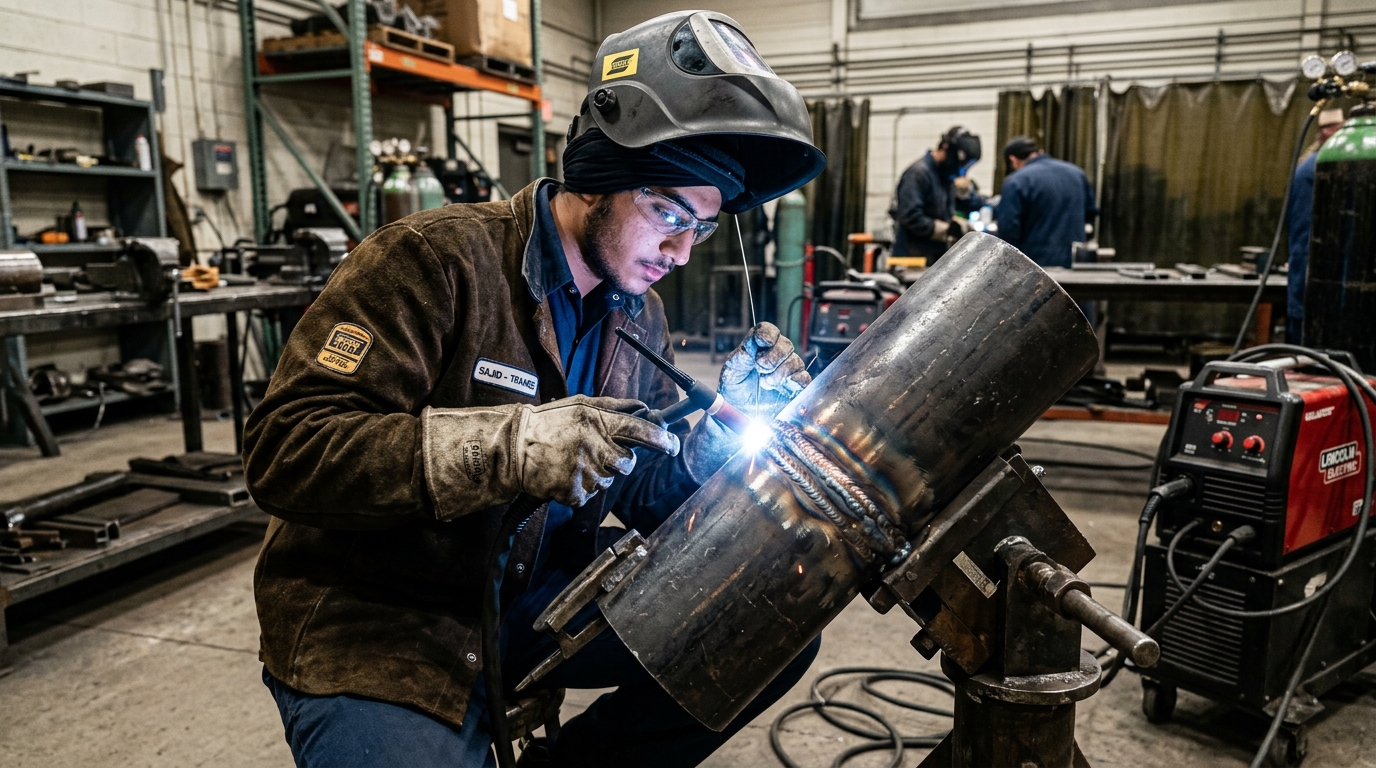
6G Practical Training
Fixed 45° pipe welding
Hands-On Workshop
Direct torch & arc practice
Safety & Procedure
PPE & workshop discipline
Trade Test Prep
Practical test readiness
Experienced Trainers
Supervised instruction
Multan Based
Usman-e-Ghani Road
What Is 6G Welding?
In industrial pipe fabrication, 6G welding refers to a specific pipe test position where the steel pipe is fixed at an inclined 45-degree angle and remains stationary throughout the entire welding procedure.
Because the pipe cannot be rotated by hand or machine, the welder must physically move their hands, torch, and body around the fixed joint. This requires mastering flat, vertical, overhead, and horizontal welding techniques all within a single continuous circular weld joint.
Key Aspects of 6G Pipe Position:
- Fixed 45° Inclined Orientation
- Non-Rotatable Stationary Pipe
- Continuous Torch & Electrode Control
- Multi-Position Weld Pool Management
- Root Pass & Penetration Control
- Hot, Fill & Cap Layering Sequence
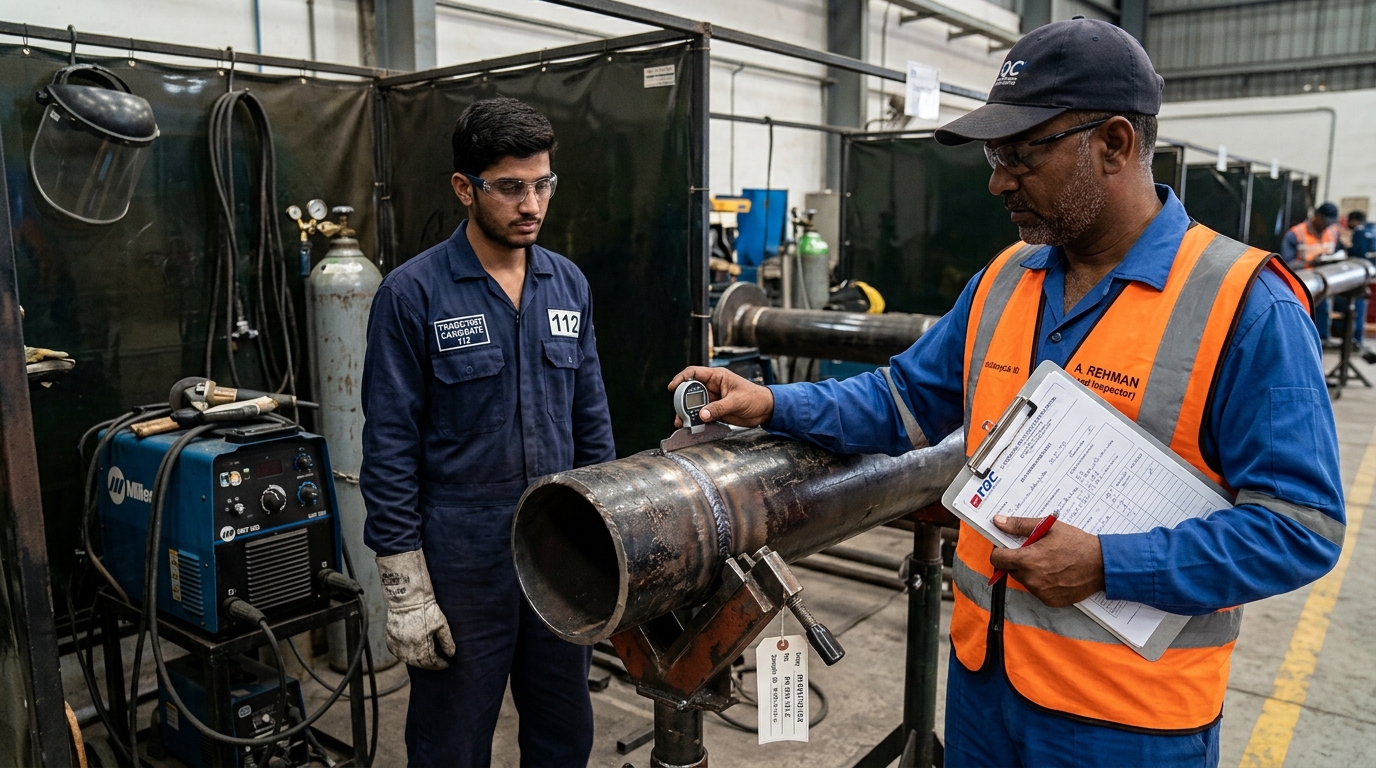
6G Inclined Test Position
Fixed 45° axis requiring multi-position torch control and bead consistency.
Why Learn 6G Welding?
Developing competence in 6G pipe welding enhances a welder's overall technical skill, electrode dexterity, and workshop confidence.
What You Learn in 6G Welding Training
A structured breakdown of the practical skills and technical techniques practiced in our workshop.
1. Pipe Joint Preparation
Cleaning pipe ends, grinding bevels, and inspecting bevel angles prior to fit-up.
2. Fit-Up Basics
Setting root gap width, root face alignment, and placing balanced tack welds.
3. Root Pass Practice
Executing keyhole penetration and continuous root bead control inside the pipe joint.
4. Hot Pass Practice
Cleaning root slag, applying the hot pass, and fusing the root layer properly.
5. Fill Pass Execution
Building up weld metal thickness with uniform stringer or weave bead passes.
6. Cap Pass Completion
Applying a clean, even cover pass with proper reinforcement and bead width.
7. Electrode Handling
Selecting electrode diameters, maintaining correct travel angles and work angles.
8. Arc Control & Heat Input
Adjusting current (amperage) settings to control arc stability and heat distribution.
9. Weld Pool Control
Managing molten weld pool fluidity across flat, vertical, and overhead positions.
10. Position Movement
Developing smooth body motion and hand transition around a fixed 45° pipe.
11. Joint Alignment
Preventing hi-lo misalignment and maintaining pipe concentricity during tacks.
12. Workshop Safety
Using welding helmets, leather gloves, protective sleeves, and ventilation.
13. Blueprint Reading
Understanding basic welding symbols, joint details, and technical specifications.
14. Procedure Awareness
Familiarity with Welding Procedure Specifications (WPS) parameters.
15. Visual Inspection
Identifying surface defects like undercut, porosity, slag inclusions, and overlap.
16. Trade Test Readiness
Timed practical exercises designed to simulate realistic trade test conditions.
Welding Processes Used in Practical Training
Trainees practice primary industrial welding processes commonly tested and utilized in pipe fabrication.
SMAW / Electric Arc Welding
Shielded Metal Arc Welding uses consumable flux-coated electrodes (such as E6010, E7018). It is fundamental for heavy structural and pipe root/fill passes in diverse field conditions.
GTAW / TIG (Argon Welding)
Gas Tungsten Arc Welding utilizes a non-consumable tungsten electrode and inert argon gas shielding. It produces high-quality, precise root passes on carbon steel and alloy piping.
GMAW / MIG (CO2 Welding)
Gas Metal Arc Welding uses a continuously fed solid wire electrode and shielding gas. It offers high deposition rates for workshop fabrication and structural sub-assemblies.
6G Welding Practical Training Process
How trainees progress through hands-on practical exercises in the workshop.
Joint & Position Setup
Position and clamp the pipe fixed at 45° inclination in the welding jig.
Edge Prep & Beveling
Inspect pipe bevel angle, clean rust/oil, and set accurate root face.
Equipment Calibration
Verify welding machine current, polarity, cables, and safety gear.
Fit-Up & Tack Welding
Set uniform root gap using spacers and place balanced tack welds.
Root Pass Execution
Weld root pass maintaining keyhole and internal root reinforcement.
Slag Cleaning & Hot Pass
Grind root bead, clean slag, and apply hot pass for solid root fusion.
Filling Passes
Deposit intermediate fill passes with proper tie-in to pipe sidewalls.
Capping Pass
Complete final cover pass maintaining even bead height and appearance.
Visual Inspection
Inspect weld surface for undercut, porosity, overlap, and reinforcement.
Supervised Repetition
Repeat practical runs under trainer feedback to build consistency.
6G Welding Workshop & Practical Equipment
Categories of tools, machinery, and safety equipment utilized during workshop practice.
Industrial Welding Power Sources
Arc and TIG welding power sources capable of stable DC output for precise current control during root and fill passes.
Pipe Sections & Test Coupons
Carbon steel pipe sections prepared with standardized bevel angles for 6G position clamping and joint fit-up practice.
Electrodes & Consumables
Standard SMAW electrodes (E6010, E7018) and GTAW filler rods suited for root pass penetration and multi-layer capping.
Grinding & Edge Prep Tools
Angle grinders, wire wheels, and root grinding disks used for cleaning interpass slag and bevel prep.
Fit-Up & Alignment Clamps
Pipe clamps, root gap gauges, hi-lo gauges, and positioner jigs for secure 45-degree angle pipe fixing.
Personal Protective Equipment (PPE)
Auto-darkening welding helmets, heavy leather welding gloves, protective jackets, and eye protection goggles.
Welding Safety During 6G Training
Safety is an integral part of practical welding instruction. Trainees learn and follow strict safety practices to protect themselves and fellow workshop members.
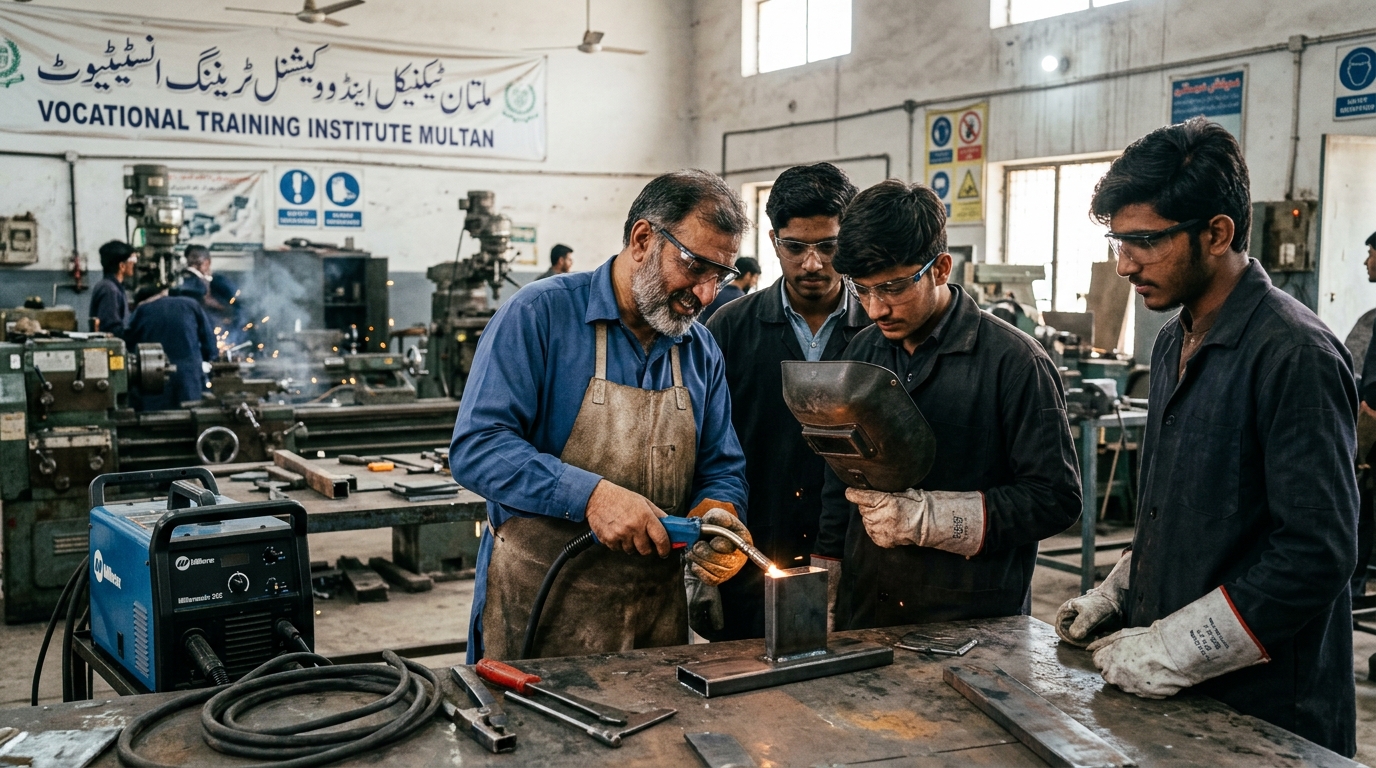
6G Welding Trade Test Preparation
Practical trade tests evaluated by technical examiners assess a welder's ability to prepare pipe joints, execute sound root penetration, maintain clean weave beads, and follow safety protocols under timed conditions.
Who Should Consider 6G Welding Training?
This course is structured for individuals aiming to develop or enhance practical pipe welding skills.
Basic Arc Welders
Welders with basic flat/vertical arc experience looking to advance into 6G inclined pipe welding practice.
Technical Students & Apprentices
Matric or diploma students seeking practical, workshop-based industrial skills to complement technical education.
Pipe Fitters & Fabricators
Fabrication tradesmen wanting to broaden their skill set by understanding pipe joint welding and fit-up quality.
Trade Test Candidates
Candidates preparing to undergo technical trade test evaluations for national or overseas employment.
Industrial Job Seekers
Individuals interested in building practical technical competence for industrial, refinery, and plant maintenance trades.
Returning Technicians
Experienced workers seeking to refresh their 6G pipe welding hand control and torch speed after a career break.
6G Welding Training Information
| Course Name | 6G Welding Course |
| Training Location | Usman-e-Ghani Road, near Brite Hall School, Multan, Punjab, Pakistan |
| Training Type | Practical Workshop & Hands-On Pipe Welding |
| Technical Focus | 6G Fixed 45° Position Pipe Welding (SMAW / GTAW / TIG) |
| Training Institute | Ashtar Trade Test & Technical Training Centre |
| Phone Inquiries | 0300-7365255 | 0300-7322762 |
| Admission & Fee Schedule | Contact Ashtar Trade Test for current course duration, fee structure, admission schedule, and available workshop training options. |
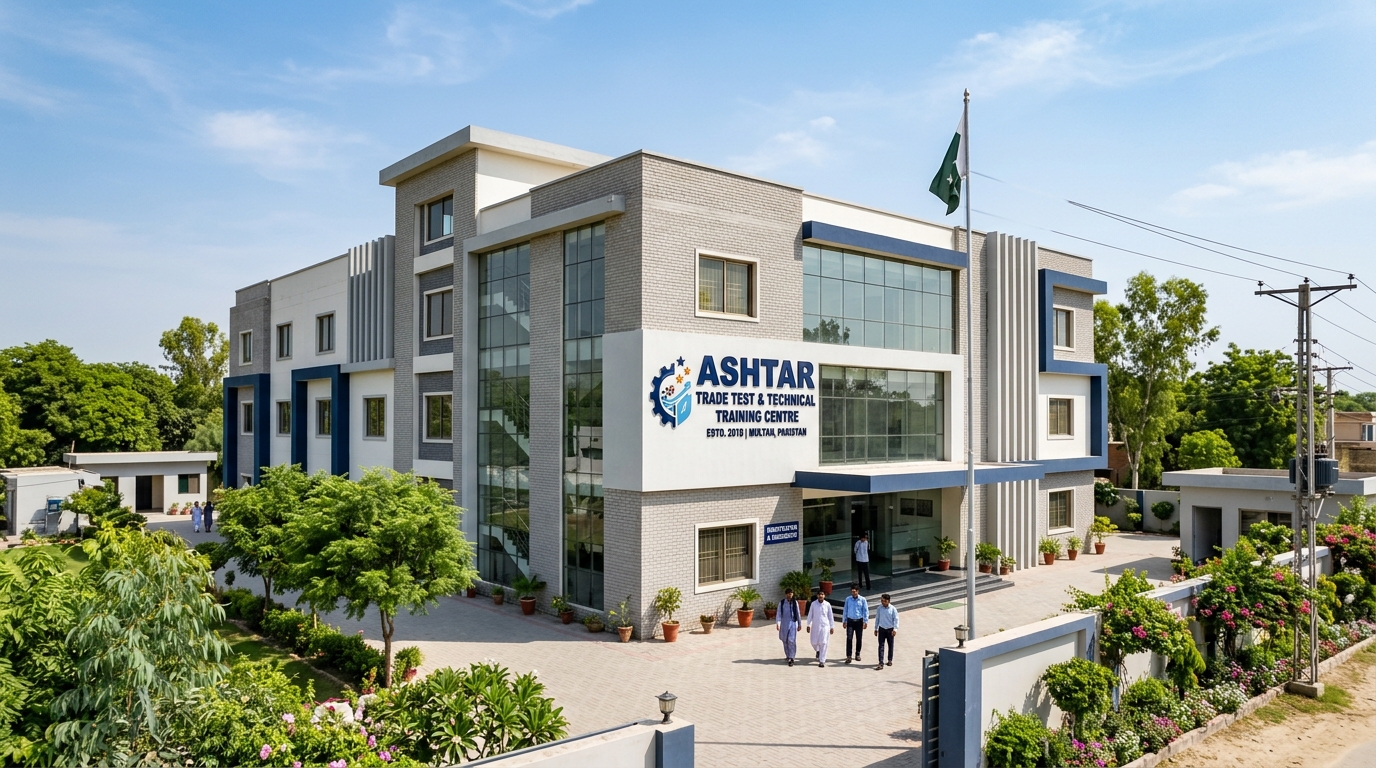
Why Choose Ashtar for 6G Welding Training?
Ashtar Trade Test & Technical Training Centre in Multan emphasizes practical technical instruction designed to help trainees build solid technical competence.
- Practical Workshop Bays: Dedicated welding booths for individual practice and torch handling.
- Experienced Technical Instructors: Supervision by trainers with real industrial welding background.
- Trade-Test-Focused Approach: Practice exercises aligned with standard technical assessment guidelines.
- Accessible Multan Campus: Conveniently located on Usman-e-Ghani Road for local and outstation trainees.
Related Courses & Technical Guides
Welding Course in Multan
Comprehensive SMAW, TIG, and MIG welding training programs in Multan.
Pipe Fitter Course
Isometric drawing reading, pipe threading, beveling, and piping assembly.
Pipe Fabricator Course
Spool template development, pipe shearing, fitting, and structural layout.
Mechanical Fitter Course
Industrial machinery overhauling, precision alignment, and pump maintenance.
Trade Test Center in Multan
Pre-departure technical skill assessment and testing facility in Multan.
Welding Trade Test Guide
What evaluators look for during practical welding trade tests.
Frequently Asked Questions About 6G Welding Course in Multan
Ready to Start 6G Welding Training?
Contact Ashtar Trade Test & Technical Training Centre in Multan to ask about current 6G welding training, admission schedule, course duration and fees.
Location: Usman-e-Ghani Road, near Brite Hall School, Multan, Pakistan
Website: www.ashtartradetest.com