
Table of Contents
- 1. Introduction: Why the Trade Test Matters
- 2. The Evaluator's Mindset: What Are They Actually Looking For?
- 3. The Ultimate Pre-Test Preparation Checklist
- 4. Top 10 Common Mistakes That Lead to Instant Failure
- 5. Trade-Specific Advice (Welders, Electricians, Plumbers, etc.)
- 6. What to Expect on Test Day (Step-by-Step Timeline)
- 7. Understanding Gulf (Saudi, UAE, Qatar) Standards
- 8. What Happens After You Pass?
- 9. Frequently Asked Questions (FAQs)
1. Introduction: Why the Trade Test Matters
For millions of skilled workers across Pakistan, India, Bangladesh, and Nepal, securing a job in the Gulf (Saudi Arabia, UAE, Qatar, Oman, Bahrain) is a life-changing opportunity. It promises better salaries, financial stability for families back home, and the chance to work on world-class mega-projects. However, standing between you and that coveted overseas employment visa is a rigorous barrier: The Trade Test.
A Trade Test is not just a formality; it is a strict, standardized practical examination designed to prove that you possess the technical skills you claim on your resume. Whether you are a pipe fitter, a 6G welder, an industrial electrician, or a heavy equipment mechanic, Gulf employers demand absolute proof of competency before they spend thousands of dollars on your visa, flights, and accommodation.
In recent years, the standards have become significantly stricter. Programs like the Saudi Skill Verification Program (SVP) have fundamentally changed the landscape of overseas recruitment. A simple interview is no longer enough. You must prove your skills in a simulated, high-pressure environment under the watchful eye of a certified evaluator.
Did You Know?
Over 40% of candidates fail their first trade test not because they lack the technical skills, but because they fail to follow safety protocols, mismanage their time, or panic under pressure. Preparation is the key to bypassing this statistic.
At Ashtar Trade Test & Technical Training Centre, we have evaluated and trained tens of thousands of candidates over the past two decades. We know exactly what evaluators are looking for, the common traps that candidates fall into, and the precise methodology required to achieve an "A" grade on your certificate.
In this comprehensive, massive 5,000+ word guide, we will break down the anatomy of a successful trade test. By the time you finish reading, you will have a clear, actionable roadmap to walk into any testing center with absolute confidence and walk out with a guaranteed job offer. Let's begin.
2. The Evaluator's Mindset: What Are They Actually Looking For?
Many candidates mistakenly believe that a trade test is solely about the final product. For example, a welder might think, "As long as the weld looks good, I will pass." This is a critical misunderstanding. Evaluators use a comprehensive scoring matrix that evaluates your entire process from start to finish. Here are the four pillars of trade test evaluation:
Safety First (The Golden Rule)
Evaluators in modern trade test centers prioritize safety above all else. Before you even touch a tool, they watch to see if you are wearing your Personal Protective Equipment (PPE) correctly. If you start welding without a mask, or cutting without goggles, you fail instantly—no matter how perfect the final job is.
Accuracy and Precision
Did you measure twice and cut once? Evaluators check your ability to read blueprints or drawings and translate those measurements accurately into reality. A millimeter off on a pipe joint or a slightly skewed angle on a fabrication piece will severely deduct points from your final score.
Time Management
Gulf employers need efficiency. A trade test is almost always timed. If you complete a perfect weld but it takes you three hours when the limit was 45 minutes, you will fail. Evaluators look for a steady, confident pace that shows you are experienced in a fast-paced industrial environment.
Problem-Solving & Methodology
They don't just look at the final product; they watch *how* you got there. Did you use the right tool for the job? Did you set up your workstation logically? If a problem arose (e.g., a jammed tool), did you handle it professionally or did you panic and force it?
Pro Tip from Ashtar Evaluators:
"We always watch the first 5 minutes the closest. How a candidate inspects the drawing, selects their tools, and organizes their workbench tells us almost everything we need to know about their experience level. A messy workbench usually means a messy final product."
3. The Ultimate Pre-Test Preparation Checklist
Success is 80% preparation and 20% execution. If you walk into a testing center blind, relying only on your past experience, you are setting yourself up for failure. Use this structured checklist to ensure you are completely ready.
1-2 Weeks Before the Test
Identify the specific testing standards (e.g., ASME Section IX for welders, BS standards for electricians).
Review theoretical knowledge. You will likely face an oral interview before or after the practical test.
Practice reading technical drawings, blueprints, and isometric charts.
Familiarize yourself with modern tools. If you've only used outdated equipment, watch videos on how modern equivalents work.
1 Day Before the Test
Prepare your original documents (Passport, CNIC, Experience Certificates).
Ensure your PPE (Safety Shoes, Overalls, Goggles) is clean and ready. Do not show up in sandals or casual clothes.
Get at least 8 hours of sleep. Fatigue leads to shaking hands and poor concentration.
Verify the exact location of the testing center and plan to arrive 1 hour early.
The Morning of the Test
Eat a healthy, light breakfast to maintain blood sugar and focus.
Drink plenty of water. Workshop environments can be hot and stressful.
Arrive early to acclimatize to the workshop environment and observe the layout.
Listen intently during the orientation briefing. Do not talk to other candidates while the evaluator is speaking.
Note: If you feel you lack preparation, consider joining a short-term preparation course. At Ashtar TTC, we offer 3-day and 7-day refresher courses specifically designed to prepare candidates for the exact scenarios they will face in the Gulf trade tests.
4. Top 6 Common Mistakes That Lead to Instant Failure
Even highly experienced professionals with 10+ years of experience fail trade tests. Why? Because they bring bad habits from their previous jobs into the testing center. A trade test is a controlled, textbook environment. You must do things "by the book," not just "how it works." Avoid these critical errors:
Ignoring Safety Protocols (PPE)
The number one reason for failure. Touching a live wire without checking, grinding without a face shield, or working without safety boots will result in immediate disqualification.
Not Asking Clarifying Questions
If the drawing is confusing, ask! Evaluators prefer a candidate who asks a smart question to ensure accuracy over a candidate who guesses and builds the wrong thing.
Poor Tool Selection
Using a wrench as a hammer or using the wrong grade of welding rod shows a fundamental lack of professional training.
Rushing to Finish First
This isn't a race. Rushing leads to sloppy joints, bad measurements, and accidents. Work at a steady, professional pace.
Failing to Clean Up
If you finish your task and walk away leaving scrap metal, wire clippings, and tools scattered across the workbench, you lose massive points for lack of housekeeping.
Arguing with the Evaluator
If an evaluator points out a flaw, accept it gracefully. Arguing or making excuses shows a poor attitude, which Gulf employers strictly avoid.
5. Trade-Specific Advice
Different trades have entirely different evaluation metrics. While safety is universal, technical precision varies wildly. Here is specific advice for the three most common Gulf trades:
For Welders (3G, 4G, 6G, TIG/MIG)
- Root Pass is Everything: If your root pass has lack of penetration or excessive convexity, you will fail before you even do the capping.
- Grinding Rules: Know the rules regarding grinding. Some tests allow grinding between passes; others do not. Ask beforehand.
- Electrode Angle: Evaluators will watch your travel speed and electrode angle closely. Maintain a consistent arc length.
- Visual Inspection: Your final weld will be checked for undercut, porosity, and spatter. Clean your weld thoroughly with a wire brush before submitting it.
For Industrial & Building Electricians
- LOTO (Lockout/Tagout): Never assume a circuit is dead. Always test with a multimeter before touching. If you skip this step, it is an instant fail.
- Wire Dressing: Gulf standards demand extreme neatness. Messy panels with crisscrossing wires will result in point deductions. Use cable ties properly.
- Termination: Ensure no exposed copper outside the terminal blocks. Tighten screws adequately—loose connections are a major red flag.
- Diagram Literacy: You will be handed a complex schematic. Take 5 minutes to read and understand it before starting. Do not rush into wiring.
For Pipe Fitters & Fabricators
- Mathematics is King: You must know how to calculate take-offs, offsets, and angles accurately. Use your formulas.
- Fit-Up Gap: Your root gap and bevel angle must be exactly as specified in the WPS (Welding Procedure Specification).
- Tacking: Ensure your tacks are strong enough to hold the pipe but small enough to be easily consumed by the welder's root pass.
- Level and Plumb: Constantly use your spirit level. A pipe system that is slightly out of level will be rejected instantly by QC inspectors in the Gulf.
6. What to Expect on Test Day (Step-by-Step Timeline)
Walking into a trade test center can be intimidating if you don't know the procedure. Here is exactly what happens from the moment you walk through the doors at a premium facility like Ashtar TTC.
Registration and Verification
You will present your original passport and CNIC. Biometrics may be taken, especially for Saudi SVP tests. You will be given a chest number or ID badge. You must wear this at all times.
Orientation and Safety Briefing
An instructor will gather all candidates and explain the rules of the workshop. They will show you where the emergency exits are, where the first aid kits are located, and explain the specific task for the day. Listen carefully.
The Theory / Oral Assessment
Before touching tools, many clients conduct a 5-10 minute verbal interview. They will ask you to identify tools, explain safety procedures, or ask you about your previous projects. Speak confidently and truthfully.
The Practical Execution (The Main Event)
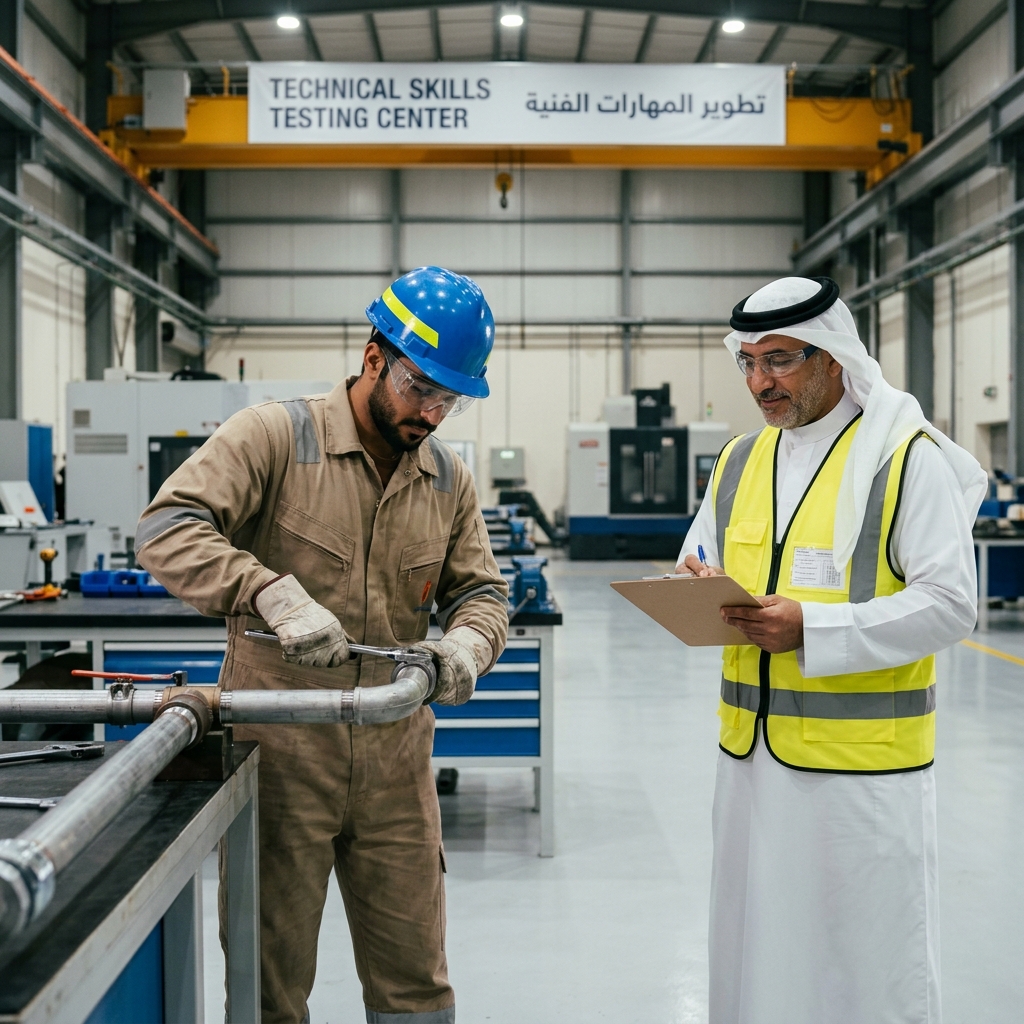
You will be assigned a workstation and given a technical drawing. The timer starts. You must select your tools, prepare your materials, and execute the job. Evaluators will walk around with clipboards, observing silently. Do not let their presence make you nervous; focus entirely on your task.
Final Inspection and Housekeeping
Once finished, you will notify the evaluator. They will inspect your work using measuring tapes, levels, or non-destructive testing (NDT) for welds. Meanwhile, you must clean your workstation and return all tools to their proper places.
7. Understanding Gulf (Saudi, UAE, Qatar) Standards
If you are taking a test specifically for Saudi Arabia, you will likely undergo the Skill Verification Program (SVP). This is a highly regulated, computer-monitored system. The theoretical part is often conducted via a computer-based multiple-choice test before the practical.
For Qatar and UAE, particularly for EPC (Engineering, Procurement, and Construction) companies and shutdown projects, the standards are based strictly on British (BS) or American (ASME/AWS/NEC) codes. Your local, informal "jugaad" methods will absolutely not be accepted. You must follow international codes.
8. What Happens After You Pass?
Congratulations! Passing the trade test is the biggest hurdle. After receiving a "Selected" or "A-Grade" status, the recruitment agency will collect your passport for visa processing. You will undergo a GAMCA medical test, sign your official offer letter, complete protectorate formalities, and finally, receive your flight ticket.