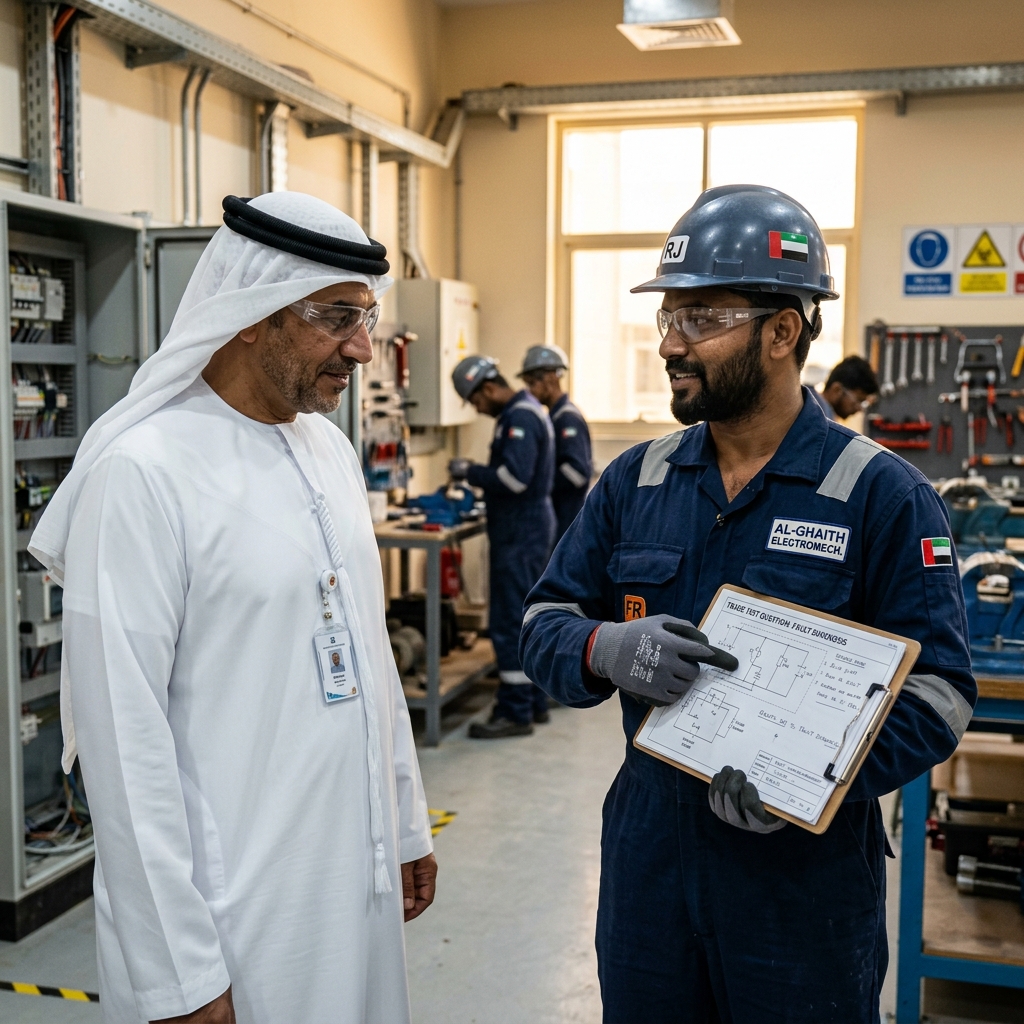
Securing a technical job in the Gulf countries (Saudi Arabia, UAE, Qatar, Oman, Kuwait, and Bahrain) requires passing a rigorous trade test. These tests evaluate your practical skills and theoretical knowledge in your specific trade. In this comprehensive guide, we've compiled the most critical trade test questions and answers for Gulf jobs, covering major trades including electricians, welders, plumbers, and pipe fitters.
Why is the Gulf Trade Test Important?
Employers in the Middle East prioritize safety, efficiency, and adherence to international standards. The trade test serves as a primary filter to distinguish between highly skilled professionals and inexperienced workers. Whether you are aiming for a position in construction, oil and gas, or facilities management, passing this test is your gateway to lucrative opportunities in the Gulf.
At Ashtart, we provide specialized preparation courses designed to help candidates ace these trade tests with confidence. If you need personalized guidance, feel free to contact our experts.
What to Expect During the Trade Test?
- Theoretical Assessment: Multiple-choice questions or oral interviews testing your knowledge of tools, safety procedures, and technical principles.
- Practical Assessment: Hands-on tasks where you must demonstrate your skills using actual tools and materials within a specific timeframe.
- Safety Compliance: Strict evaluation on your use of Personal Protective Equipment (PPE) and adherence to occupational safety standards.
Electrician Trade Test Q&A
Electrical trade tests in the Gulf focus heavily on industrial installations, motor control circuits, and safety standards like BS7671 or local DEWA/KAHRAMAA regulations.
Q1:What is Ohm's Law and how is it applied in electrical circuits?
Answer:Ohm's Law states that the current (I) passing through a conductor between two points is directly proportional to the voltage (V) across the two points and inversely proportional to the resistance (R). The formula is V = I × R. It is used to calculate required resistor values, determine circuit current, and troubleshoot voltage drops in commercial and industrial wiring.
Q2:Explain the difference between a MCB and an MCCB.
Answer:MCB (Miniature Circuit Breaker) is used for low current applications, typically up to 100 Amps, and has a fixed trip setting. MCCB (Molded Case Circuit Breaker) is designed for higher current ratings (up to 2500 Amps) and often features adjustable trip settings for both overload and magnetic (short circuit) protection, making it suitable for industrial panel boards.
Q3:What is the purpose of Earthing (Grounding), and what is an acceptable earth resistance value for residential/commercial buildings?
Answer:Earthing provides a safe path for fault current to flow to the ground, protecting humans from electric shock and preventing damage to equipment. For general residential and commercial installations, the earth resistance should ideally be less than 5 Ohms, though less than 1 Ohm is required for sensitive industrial and medical equipment.
Q4:How does a Residual Current Circuit Breaker (RCCB) work?
Answer:An RCCB detects imbalances between the live (phase) and neutral currents. Under normal conditions, the current flowing in equals the current flowing out. If there is a leakage to ground (e.g., a person touching a live wire), the currents become unbalanced. The RCCB detects this residual current (usually 30mA for human protection) and trips the circuit instantly.
Q5:What is Star-Delta starting for induction motors, and why is it used?
Answer:Star-Delta is a starting method used for 3-phase induction motors to reduce the high starting current. Initially, the motor windings are connected in a Star configuration, reducing the voltage across each winding to 1/√3 (about 58%) of the line voltage. Once the motor reaches a certain speed, a timer switches the connection to Delta, applying full voltage. This prevents voltage dips in the supply system.
Q6:What is the function of a contactor in a control circuit?
Answer:A contactor is an electrically controlled switch used for switching a power circuit. Unlike standard relays, contactors are designed to handle high current loads directly, such as motors, lighting banks, or heaters. They are controlled by a lower voltage circuit and feature arc-suppression mechanisms to handle the heavy arc when interrupting motor currents.
Q7:Explain Power Factor and why a low power factor is undesirable.
Answer:Power Factor (PF) is the ratio of Real Power (kW) to Apparent Power (kVA). It measures how effectively electrical power is being used. A low PF (caused by inductive loads like motors and transformers) means higher current is drawn from the supply to perform the same work, leading to increased line losses (I²R), overheating of cables, and penalty charges from the utility company.
Q8:How do you test a capacitor using a digital multimeter?
Answer:First, safely discharge the capacitor. Set the multimeter to the capacitance mode (if available) and read the microfarad value; it should match the label. Alternatively, using resistance (Ohms) mode: connect the probes to the terminals. The resistance should start low and gradually increase to infinity as the multimeter's battery charges the capacitor. If it reads zero (shorted) or infinity immediately (open), the capacitor is faulty.
Q9:What are the standard color codes for 3-phase AC wiring in the Gulf (IEC standard)?
Answer:According to the IEC standards widely adopted in the Gulf: Phase 1 (L1) is Brown, Phase 2 (L2) is Black, Phase 3 (L3) is Grey. Neutral (N) is Blue, and Earth/Ground (E) is Green-and-Yellow striped.
Q10:What is a Variable Frequency Drive (VFD) and what are its main components?
Answer:A VFD is an electronic controller that adjusts the speed and torque of an AC electric motor by varying the frequency and voltage supplied to it. Its main components are the Rectifier (converts AC to DC), the DC Bus/Filter (smoothes the DC voltage using capacitors), and the Inverter (uses IGBTs to convert DC back to variable-frequency AC).
Welder Trade Test Q&A (SMAW, TIG, MIG)
Welders in the Gulf oil, gas, and construction sectors must demonstrate exceptional precision. The 6G pipe welding test is standard for high-paying positions.
Q1:What is TIG welding, and what shielding gas is most commonly used?
Answer:TIG (Tungsten Inert Gas) welding, or GTAW, uses a non-consumable tungsten electrode to produce the weld. The weld area is protected from atmospheric contamination by an inert shielding gas. Argon is the most commonly used shielding gas, sometimes mixed with Helium for deeper penetration on thicker materials.
Q2:Explain the term '6G position' in pipe welding.
Answer:The 6G position is one of the most challenging pipe welding positions and is the standard for certifying pipe welders for Gulf jobs. In 6G, the pipe is fixed at a 45-degree angle (inclined) and cannot be rotated. The welder must weld around the entire pipe, moving through flat, vertical, and overhead positions continuously.
Q3:What is the purpose of baking Low Hydrogen electrodes (like E7018) before use?
Answer:Low hydrogen electrodes (E7018) have flux coatings that easily absorb moisture from the air. If moisture is present during welding, the heat breaks it down into hydrogen, which enters the weld pool and causes Hydrogen-Induced Cracking (cold cracking). Baking the electrodes in an oven at 250-300°C removes this moisture, ensuring a sound, crack-free weld.
Q4:What causes 'Porosity' in a weld, and how can you prevent it?
Answer:Porosity consists of gas pockets or voids in the weld metal. It is caused by inadequate shielding gas coverage, drafts blowing the shielding gas away, moisture on the base metal or in the electrode, or dirty base metal (oil, rust, paint). Prevention involves proper cleaning, ensuring adequate gas flow, and shielding the weld area from wind.
Q5:In SMAW (Stick Welding), what do the numbers in 'E7018' mean?
Answer:E stands for Electrode. The '70' indicates the minimum tensile strength of the deposited weld metal is 70,000 psi. The '1' indicates the electrode can be used in all welding positions (flat, horizontal, vertical, overhead). The '8' specifies the type of flux coating (low hydrogen, iron powder) and the welding current (AC or DC+).
Q6:What is undercut in welding, and what are its main causes?
Answer:Undercut is a groove melted into the base metal adjacent to the weld toe or weld root and left unfilled by weld metal. It creates a stress concentration point that weakens the joint. Main causes include excessive welding current, too fast travel speed, incorrect electrode angle, or weaving too widely.
Q7:Describe the difference between DCEN and DCEP in DC welding.
Answer:DCEN (Direct Current Electrode Negative), also known as straight polarity, connects the electrode to the negative terminal. It provides deeper penetration and is common in TIG welding. DCEP (Direct Current Electrode Positive), or reverse polarity, connects the electrode to the positive terminal. It provides shallower penetration but better cleaning action and is standard for most stick (SMAW) and MIG (GMAW) welding.
Q8:What is a root pass, and why is it critical in pipe welding?
Answer:The root pass is the first weld bead deposited in a multi-pass joint, joining the two pieces at the root (bottom) of the groove. It is critical because it fuses the inside edges of the pipe. Complete penetration and proper fusion in the root pass are essential to prevent leaks and structural failure, as subsequent passes build upon it.
Q9:How do you check for weld defects after completing a weld?
Answer:Initial checking is done via Visual Inspection (VT) for surface defects like undercut, porosity, or poor profile. For internal defects, Non-Destructive Testing (NDT) methods are used, such as Dye Penetrant Testing (PT) for surface cracks, Magnetic Particle Testing (MT), Radiographic Testing (RT/X-ray), or Ultrasonic Testing (UT) for internal flaws.
Q10:What is the function of the flux coating on an SMAW electrode?
Answer:The flux coating serves multiple functions: it produces a shielding gas when heated to protect the molten pool from oxygen and nitrogen; it forms a slag covering to protect the cooling weld and slow its cooling rate; it provides deoxidizers to clean the weld metal; and it adds alloying elements to enhance the mechanical properties of the weld.
Plumber & Pipe Fitter Trade Test Q&A
Plumbing and pipe fitting roles in the Gulf require extensive knowledge of varied materials (PPR, CPVC, ERW steel) and high-rise building regulations.
Q1:What is the purpose of a P-trap in plumbing systems?
Answer:A P-trap is a U-shaped pipe section located under sinks and drains. Its primary purpose is to hold a small amount of water, creating a water seal. This seal prevents foul sewer gases, odors, and potentially harmful insects from entering the building through the drain pipes.
Q2:How do you determine the correct pipe size for a water supply line?
Answer:Pipe sizing is determined using Water Supply Fixture Units (WSFU), which calculate the total water demand based on the number and type of fixtures (toilets, sinks, showers). The size also depends on water velocity limits, available pressure, and friction losses due to pipe length, fittings, and material type.
Q3:What is water hammer, and how can it be prevented?
Answer:Water hammer (hydraulic shock) is a loud banging noise caused by a sudden stop or change in the direction of water flow when a valve is closed abruptly. It creates a shockwave that can damage pipes and fittings. It is prevented by installing water hammer arrestors (air chambers) that act as cushions to absorb the shockwave.
Q4:Explain the difference between PPR, UPVC, and CPVC pipes.
Answer:UPVC (Unplasticized Polyvinyl Chloride) is used for cold water, drainage, and sewage; it cannot handle hot water. CPVC (Chlorinated PVC) can handle higher temperatures (up to 90°C) and is used for hot and cold potable water. PPR (Polypropylene Random Copolymer) is thick-walled, uses heat-fusion jointing, is highly durable, and is excellent for high-pressure hot and cold water systems.
Q5:What is a hydrotest in piping systems, and how is it conducted?
Answer:A hydrotest (hydrostatic test) is conducted to verify the structural integrity and leak-tightness of a piping system. The system is filled with water, air is bled out, and it is pressurized using a pump to a specific test pressure (usually 1.5 times the operating pressure). The pressure is held for a specified duration while inspecting for pressure drops and visible leaks.
Q6:What are the standard gradients (slopes) required for drainage pipes?
Answer:For gravity drainage systems to achieve self-cleansing velocity (preventing blockages), a general rule is a slope of 1:40 (2.5%) for smaller pipes (up to 100mm/4 inch) and 1:60 to 1:80 for larger pipes. A minimum of 1/4 inch fall per foot is a common standard in many plumbing codes.
Q7:Describe the function of a PRV (Pressure Reducing Valve).
Answer:A Pressure Reducing Valve is installed on the main water supply line to automatically reduce high incoming city water pressure to a lower, safer, and more consistent pressure for the building's plumbing system. This protects pipes, fixtures, and appliances from damage due to excessive pressure.
Q8:What is a vent stack, and why is venting crucial in plumbing?
Answer:A vent stack is a vertical pipe that runs to the outside (usually through the roof). Venting allows air to enter the drainage system, equalizing pressure. Without venting, the rush of wastewater down a drain can create a vacuum (siphon effect) that sucks the water out of P-traps, destroying the water seal and allowing sewer gases into the building.
Q9:How do you join PPR pipes?
Answer:PPR pipes are joined using socket fusion welding (heat fusion). A specialized heating tool melts the outer surface of the pipe and the inner surface of the fitting simultaneously. Once molten, the pipe is inserted into the fitting, and they fuse together to form a permanent, homogenous, leak-proof joint.
Q10:What is the difference between a Gate Valve and a Globe Valve?
Answer:A Gate Valve uses a wedge-like gate that moves perpendicular to the flow; it is used primarily for fully open or fully closed operations (isolation) and should not be used for throttling flow. A Globe Valve has a spherical body and a plug that closes against a seat parallel to the flow; it is specifically designed for regulating and throttling flow, though it causes a higher pressure drop.
Frequently Asked Questions
How can I apply for a trade test for Gulf jobs?
You can apply through government-approved overseas employment agencies or certified technical training institutes like Ashtart. Always verify the agency's license to avoid scams.
Is English proficiency required to pass the trade test?
Basic English is highly recommended as most technical diagrams, safety signs, and manuals in the Gulf are in English. However, many trade test centers have instructors who can explain the practical tasks in regional languages.
What happens if I fail the practical portion of the trade test?
If you fail, you usually have the option to retake the test after a certain period. We strongly advise taking a short-term skill upgrade course before re-attempting.
Are these trade test certificates valid in all GCC countries?
Certificates from reputed testing centers are generally accepted across the GCC (Saudi Arabia, UAE, Qatar, Oman, Bahrain, Kuwait), but specific employers may require their own standard tests.
How long does a typical trade test last?
A trade test typically takes between 2 to 4 hours. It involves a written/oral theory session followed by a timed practical task.