TEVTA Courses in Multan – Technical and Vocational Training Guide for Pakistan
Navigating technical and vocational education in Pakistan requires clear, verified information. Whether you are researching public-sector TEVTA courses in Multan, exploring technical diplomas across Punjab, or comparing polytechnic institutes with specialized private practical workshop training, this definitive guide provides objective insights into course types, eligibility criteria, admission frameworks, and overseas industrial career preparation.
- Provincial Scope:Punjab, Sindh (STEVTA), KP (KP-TEVTA), Balochistan (B-TEVTA), and Federal NAVTTC standards.
- Major Technical Tracks:3-Year DAE Engineering, 1-Year Vocational Certificates, and 1-to-3 Month Intensive Skill Modules.
- Key Multan Hubs:Government College of Technology (GCT), GTTIs, and specialized private trade testing bays.
- Global Employment:Gulf recruitment delegation assessments (Aramco, ADNOC, QatarEnergy contractor qualifications).
Guide Table of Contents – Quick Navigation
What Is TEVTA? Understanding Technical & Vocational Education in Pakistan
TEVTA stands for the Technical Education and Vocational Training Authority. Established initially under the Punjab TEVTA Ordinance in 1999 and subsequently codified under the TEVTA Act 2010, the authority was formed to consolidate, upgrade, and coordinate technical education and vocational training institutes previously dispersed across multiple government departments.
Before TEVTA’s inception, polytechnic colleges were managed by the Department of Education, apprenticeship training schemes were supervised by the Department of Labour, and vocational centres were run by the Department of Social Welfare. This fragmentation resulted in mismatched syllabi, inconsistent examination standards, and redundant administrative costs. TEVTA unified hundreds of public institutes under a single governing body.
The Distinct Roles of TEVTA, PBTE, and NAVTTC
Many prospective students confuse training bodies with examination boards. In Punjab’s technical education architecture:
- TEVTA (The Training Provider): Operates the physical institutes, hires instructional faculty, procures machinery, develops course curricula, and runs government colleges such as GCTs and GVTIs.
- PBTE (Punjab Board of Technical Education): The statutory examination and certification authority. PBTE conducts centralized examinations, tabulates roll numbers, issues official diplomas (such as DAE), and maintains official result registries.
- NAVTTC (National Level Body): The National Vocational and Technical Training Commission is the federal regulatory body under the Ministry of Federal Education. NAVTTC sets National Vocational Qualification Framework (NVQF) standards, oversees international accreditation, and facilitates nationwide skill development schemes like Prime Minister youth skill initiatives.
Official Public Portals
Always consult authorized government channels to verify admission notices, seat quotas, and statutory program lists:
TEVTA Courses in Pakistan – Comprehensive Technical & Vocational Categories
Technical training programs in Pakistan are designed across several technical and industrial sectors. Rather than relying on outdated lists, prospective applicants should understand the core disciplinary clusters offered through public polytechnics and vocational centres across Punjab and the broader Pakistani vocational landscape:
1. Welding & Metal Fabrication
Plate and pipe jointing technologies for heavy industrial fabrication, oil & gas lines, boiler manufacturing, and structural steel plants.
- • Shielded Metal Arc Welding (SMAW / Stick)
- • Gas Tungsten Arc Welding (GTAW / TIG)
- • Gas Metal Arc Welding (GMAW / MIG)
- • 6G High-Pressure Pipe Welding & Fabrication
2. Industrial Pipe Fitting & Piping
Process plant piping, isometric blueprint interpretation, spool fabrication, flange leveling, and refinery pipeline assembly.
- • Industrial Pipe Fitter & Fabricator
- • Piping Isometric Blueprint Reading
- • Spool Fit-Up & Flange Alignment
- • Hydrotesting & Piping Safety Standards
3. Electrical & Power Technologies
Power generation, commercial wiring, industrial automation, substation switchgear maintenance, and renewable solar energy.
- • Industrial Electrician & Motor Controls
- • DAE Electrical Technology (3 Years)
- • Solar PV Installation & Inverter Systems
- • Substation Maintenance & Cable Splicing
4. Mechanical Trades & Machining
Precision metal machining, rotary equipment maintenance, pump alignment, mechanical fitting, and CNC machine operation.
- • Mechanical Fitter (Bearings, Shafts, Couplings)
- • Machinist (Lathe, Shaper, Milling)
- • CNC Machine Programming & Turning
- • DAE Mechanical Engineering Technology
5. Civil & Construction Surveying
Infrastructure measurement, architectural AutoCAD drafts, land surveying with Total Station, and material quality assurance.
- • Civil Surveyor & Total Station Operator
- • Quantity Surveyor & Cost Estimator
- • DAE Civil Technology (3 Years)
- • AutoCAD 2D & 3D Drafting
6. HVACR & Industrial Cooling
Heating, ventilation, air conditioning, and commercial refrigeration plant commissioning, chiller servicing, and gas charging.
- • Refrigeration & Air Conditioning (RAC)
- • Central Chiller Plant Operation
- • Commercial Cold Storage Maintenance
- • Heat Load Calculation & Duct Installation
TEVTA Courses in Multan – Public Infrastructure & Regional Industrial Reality
Multan is the industrial and economic heart of South Punjab. With major textile mills, fertilizer plants, seed processing units, thermal power stations, and a vast community of technicians bound for Gulf overseas employment, the demand for practical technical skills in Multan is extraordinarily high.
Major Public Technical Institutes in Multan
Government technical education in Multan District operates primarily through well-known public campuses:
- Government College of Technology (GCT) MultanLocated in Qasimpur Colony / Industrial Estate area. The primary public institution offering 3-year DAE programs in Mechanical, Civil, Electrical, and Chemical disciplines.
- Government Technical Training Institute (GTTI) MultanFocuses on 6-month to 1-year trade certificates such as Machinist, Welder, Electrician, and Auto Mechanic under PBTE supervision.
- Government Vocational Training Institutes (GVTI) for Women & BoysConducts community vocational courses, office management, computer applications, and basic craft trades across various Multan tehsils.
How to Verify Multan Public Admissions
When applying to public-sector colleges in Multan, follow these verified procedures:
- Check Official Newspaper Ads: TEVTA Punjab releases central admission advertisements in national dailies (Jang, Express, Dawn) during July/August for regular morning sessions and December/January for spring batches.
- Visit Official Campus Admissions Desks: Always visit the physical student affairs window at GCT Multan or GTTI to verify actual seat allotments, open merit vs quota requirements, and genuine prospectus forms.
- Confirm Shift & Fee Type: Clarify whether you are applying for Morning Regular Shift (heavily government subsidized) or Evening Second Shift (Self-Finance scheme with higher fee structures).
Technical and Vocational Training Across Pakistan – Provincial Ecosystems
A common misconception among applicants is that TEVTA Punjab governs technical education across all of Pakistan. Under the 18th Constitutional Amendment, education and vocational training are decentralized provincial subjects. Each province maintains its own autonomous statutory authority:
| Province / Region | Autonomous Authority | Examining Board | Official Web Portal |
|---|---|---|---|
| Punjab | TEVTA Punjab | Punjab Board of Technical Education (PBTE) | tevta.gop.pk |
| Sindh | STEVTA (Sindh TEVTA) | Sindh Board of Technical Education (SBTE) | stevta.gos.pk |
| Khyber Pakhtunkhwa | KP-TEVTA | KPK Board of Technical Education (BTE) | kptevta.gov.pk |
| Balochistan | B-TEVTA | Balochistan Technical Education Board | btevta.gob.pk |
| Islamabad (Federal) & AJK/GB | NAVTTC & Regional Directorates | Federal Certification / PBTE Affiliations | navttc.gov.pk |
To ensure that a certificate earned in Multan is recognized equally in Karachi, Peshawar, Quetta, or internationally in Dubai and Riyadh, Pakistan established the NVQF overseen by NAVTTC. The framework benchmarks competency levels from Level 1 (basic operator) up to Level 5 (diploma technologist). When choosing any technical course, verify whether the curriculum adheres to Competency-Based Training and Assessment (CBT&A) standards.
Short Courses, Diplomas (DAE), and Trade Test Preparation – Key Differences
Choosing the wrong training path costs valuable time and money. A common dilemma for matriculates and young workers is deciding between a multi-year academic diploma, a standardized government short course, and an intensive hands-on trade test preparation course:
| Feature | 3-Year DAE Diploma | Govt Vocational Certificate | Private Trade Test Prep |
|---|---|---|---|
| Target Objective | Supervisory technician, engineering diploma, higher education entry | Entry-level trade literacy, basic workshop orientation | Passing Gulf client tests (Saudi Aramco, ADNOC, Qatar) |
| Typical Duration | 3 Years (Annual Academic System) | 6 Months to 1 Year | 15 Days to 2 Months (Intensive) |
| Entry Requirements | Matric with Science (Physics, Chem, Math) with minimum 45% | Matric (Arts/Science) or Middle School pass | Prior basic trade familiarity or motivation to learn hands-on |
| Theory vs Practical | 60% Theory / 40% Lab | 40% Theory / 60% Practical | 10% Theory / 90% Pure Workshop Booths |
| Examining Body | Punjab Board of Technical Education (PBTE) | PBTE / Trade Testing Board (TTB) | Foreign Employer Delegations / In-house Verification |
| Overseas Job Readiness | Strong theoretical grounding; requires practical booth speed training | Basic grounding; often lacks speed and high-pressure pipe standards | Immediate: Rehearses exact client coupons & X-ray standards |
Admission Process and Eligibility Guide for Technical Courses
Follow this verified 8-step framework to successfully secure admission in technical training institutions without falling victim to unverified agents or misinformation:
Identify Target Trade & Career Goal
Determine whether your aim is long-term academic qualification (e.g. DAE for supervisor roles) or fast-track practical mastery (e.g. 6G welding or pipe fitting for overseas Gulf recruitment).
Locate Authorized Campuses & Institutes
Check whether your chosen trade is taught at GCT Multan, a local GTTI, or a specialized private workshop such as Ashtar Trade Test Centre on Usman-e-Ghani Road, Multan.
Verify Official Admission Cycles
Public polytechnics open regular DAE admissions in July/August following the announcement of BISE Matriculation board results. Private training institutes offer rolling, flexible weekly/monthly batch enrolments.
Check Academic & Age Criteria
DAE requires Matric with Science (minimum 45% marks) and maximum age limit usually around 22 years (subject to official relaxations). Vocational short courses generally accept Middle or Matric (Arts/Science) with flexible age limits.
Prepare Document Dossier
Prepare attested photocopies of your Matric Sanad or Result Card, CNIC or NADRA Smart B-Form, Father's CNIC, Domicile certificate, 4 to 6 passport-size photographs, and a character certificate.
Review Fees & Shift Schemes
Government regular morning shifts have nominal tuition fees subsidized by the state. Evening second-shift programs operate on a self-finance basis with higher fees. Always demand an official fee voucher.
Inspect Workshop Bays & Tools
Never pay fees before physically inspecting the workshop. Confirm that students receive individual welding booths, live pipe spools, electrodes, and safety gear, rather than purely classroom lectures.
Complete Orientation & Safety Briefing
Begin your training with industrial Personal Protective Equipment (PPE)—safety boots, welding shields, leather aprons, and ear protection—ensuring safe practical mastery from day one.
Industrial Welding and Fabrication Training in Depth
Welding and metal fabrication represent the backbone of heavy industrial construction, petrochemical refineries, thermal power stations, and pipeline networks. Across Pakistan and throughout Gulf recruitment campaigns, certified multi-welders and high-pressure pipe welders command premium salaries.
Key Welding Processes Taught:
- SMAW (Shielded Metal Arc Welding / Stick):Mastering 1G to 4G plate welding with E6010, E6013, and low-hydrogen E7018 electrodes, progressing to 5G and 6G fixed pipe positions on carbon steel spools.
- GTAW (Gas Tungsten Arc Welding / TIG / Argon):High-precision root pass welding using ER70S-6 filler wires, pure argon shielding gas, high-frequency arc initiation, and back-purging on stainless steel and chrome-moly alloy pipes.
- GMAW & FCAW (MIG & Flux-Cored Arc Welding):High-deposition semi-automatic welding for heavy structural fabrication shops, shipyards, and storage tank erection.
Weld Inspection & Quality Criteria
Industrial trade testing is ruthless. Coupons must be completely free of undercut, lack of side-wall fusion, root suck-back, porosity, and slag inclusions. Trainees practice grinding, bevel preparation (37.5° angle), feather-edge land, and root gap setting before undergoing destructive guided root-bend and face-bend tests, as well as Radiographic Testing (RT) X-ray simulations.
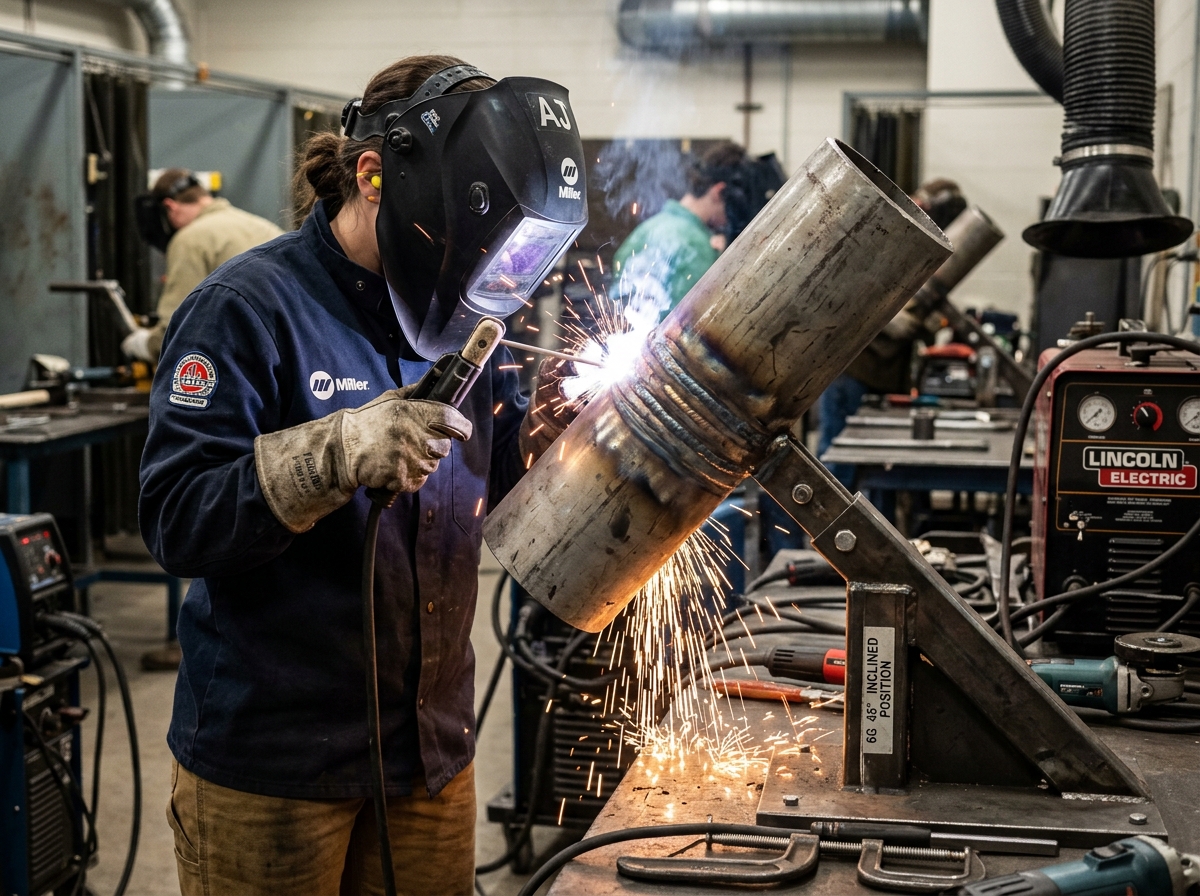
All practical welding bays enforce strict health and safety protocols: auto-darkening welding helmets (DIN 9-13 shade), heat-resistant split-cowhide leather gloves, flame-retardant welding jackets, steel-toe safety boots, and localized fume extraction systems.
Pipe Fitting and Industrial Piping Engineering
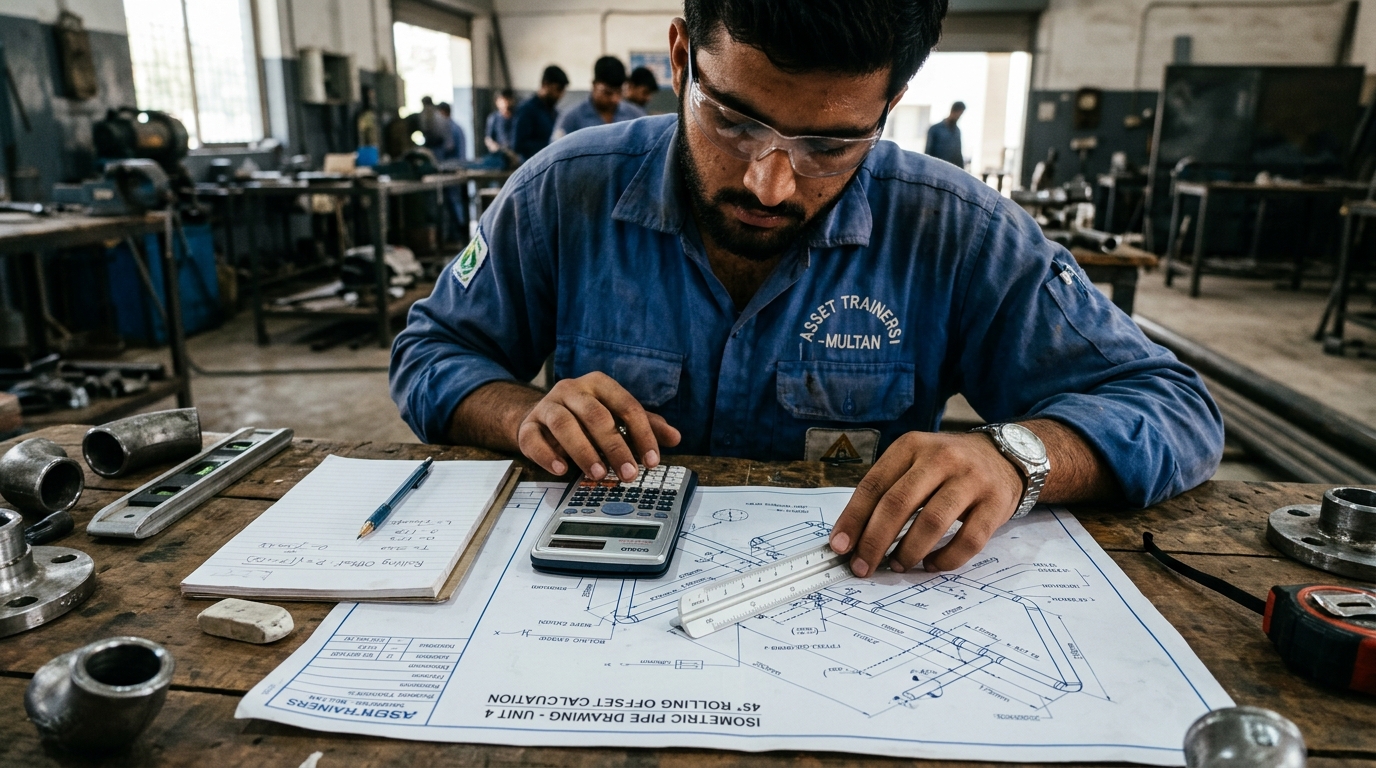
- • Travel = Offset × 1.414 (for standard 45° offset)
- • Run = Set = Offset × 1.000
- • Elbow Center (90° Long Radius) = 1.5 × Nominal Pipe Size
- • Take-Off = Center-to-Face Dimension of Fitting
While welding creates permanent joints, the pipe fitter and pipe fabricator determine whether those joints are positioned accurately according to engineering plant drawings. In oil refineries, power stations, fertilizer complexes, and chemical processing facilities, piping systems must align with millimeter precision.
Pipe Fitter vs Pipe Fabricator: A Critical Distinction
Essential Curriculum Modules
- Piping Isometric Blueprints: North arrow orientation, coordinate systems (Northing, Easting, Elevation), bill of materials (BOM), weld symbols, and revision clouds.
- Flange Alignment & Fit-Up: Two-hole leveling across horizontal and vertical centerlines, high-low alignment gauges, root-gap wedges, and gap tolerances.
- Piping Components: Weldolets, sockolets, concentric and eccentric reducers, weld-neck flanges, slip-on flanges, globe and ball valves, and orifice plates.
Government vs Private Technical Training – An Objective Comparison
Both government polytechnic institutes and private technical training centres serve vital functions in Pakistan's workforce development. Neither is universally superior—the right choice depends entirely on your educational background, timeline, and employment targets:
| Decision Factor | Government TEVTA / GCT Colleges | Specialized Private Centres (e.g. Ashtar) |
|---|---|---|
| Institutional Ownership | Public sector, state-funded, statutory administration under provincial TEVTA. | Private enterprise, independent workshop management. |
| Curriculum & Pace | Standardized academic syllabus (fixed 1-year or 3-year timelines), annual examinations. | Fast-track, modular, industry-driven, daily hands-on workshop drills. |
| Practical Machine Time | Shared equipment among large class batches (often 30-50 students per lab session). | Dedicated individual welding booths, continuous arc time, focused instructor coaching. |
| Fee & Cost Structure | Highly subsidized nominal tuition for morning seats; moderate for second-shift. | Commercial fees based on direct consumable costs (heavy pipe spools, argon gas, welding rods). |
| Certification Body | Official government diplomas issued by Punjab Board of Technical Education (PBTE). | Institutional completion certificates & direct foreign trade test qualification. |
| Best Suited For | Matriculates seeking formal government diplomas, higher engineering admission, or local public jobs. | Candidates preparing for immediate overseas Gulf recruitment delegations (Saudi Arabia, UAE, Qatar). |
Trade Test Preparation – What It Is and How Foreign Delegations Test
A Trade Test is a standardized practical examination conducted by overseas recruitment delegations, engineering contractors, or third-party testing agencies (such as Bureau Veritas, TUV, or Lloyd's Register) to evaluate a craftsman's physical competence before issuing an overseas employment visa.
Throughout Saudi Arabia, the United Arab Emirates, Qatar, Kuwait, Oman, and Bahrain, major projects (such as Saudi Aramco expansions, ADNOC refineries, NEOM infrastructure, and QatarEnergy LNG plants) enforce strict quality codes (ASME Section IX, AWS D1.1, API 1104). They do not hire based on paper degrees alone—candidates must step into a test booth and produce flawless work under timed conditions.
Why Candidates Fail Trade Tests:
At Ashtar Trade Test Centre Multan, our workshop bays simulate real recruitment delegation environments:
- Individual heavy-duty welding booths with calibrated Miller & Lincoln power sources.
- ASTM A106 Grade B pipe spools (2-inch to 8-inch diameter, Schedule 40 & 80).
- In-house root and face bend testing jigs to inspect weld ductility before official delegation trials.
- Live isometric drawing blueprint drills for pipe fabricators.
How to Choose the Right Technical Course – Candidate Evaluation Checklist
Use this structured checklist before paying admission fees to any technical training institute in Pakistan:
If you have Matric Science with strong mathematics, a 3-year DAE diploma opens doors to engineering technologist paths. If you have Middle or Matric Arts, practical trade courses like pipe fitting or welding offer faster job entry.
Can you afford 3 full academic years without full-time earnings, or do you need to enter the job market or go to the Gulf within 2 to 3 months? Choose your program duration accordingly.
Do you excel in manual dexterity, hand-eye coordination, and physical tools, or do you prefer computer drafting and calculations? Trades like 6G welding demand steady hands, while surveying requires geometry.
Always visit the institute in person. Count the number of functional machines. If 40 students are crowding around a single lathe machine or welding booth, practical mastery is impossible.
Inquire explicitly: Are welding electrodes, pipes, grinding discs, and shielding gases included in the fee, or will the institute charge you extra every time you practice a weld coupon?
Verify whether the trade is currently in demand by foreign overseas recruiting agencies. Currently, certified 6G TIG/ARC pipe welders, pipe fabricators, and industrial electricians remain among the highest demanded categories.
Why Consider Ashtar Trade Test & Technical Training Centre?
Located on Usman-e-Ghani Road, Multan, Ashtar Trade Test & Technical Training Centre is an established, specialized private institution dedicated to hands-on industrial skills and rigorous trade test qualification.
We do not believe in confining technical learners to desks. From day one, candidates spend their hours inside dedicated welding bays, pipe fabrication tables, and mechanical assembly benches.
Our training directly matches the examination environments of Saudi Arabian, UAE, and Qatari recruitment delegations, with strict adherence to timed coupon preparation, fit-up, and destructive root-bend tests.
Trainees are guided by master craftsmen with decades of field experience in oil refineries, fertilizer plants, and cross-country pipelines across Pakistan and the Middle East.
Our Verifiable Institutional Principles
- Honest Identity: We are an independent private technical training facility. We are not a government TEVTA campus and never falsely claim government status.
- No Fake Guarantees: We do not sell paper certificates or promise guaranteed foreign visas. We build genuine, undeniable physical trade skills that speak for themselves in front of any client tester.
- Transparent Inquiries: Prospective trainees and their guardians are invited to visit our Multan campus, inspect our active workshop booths, and observe current students before enrolling.
Nationwide Educational Information – Dedicated Local Campus in Multan
This informational guide is published for technical students, apprentices, and technical job seekers across all regions of Pakistan—including Lahore, Faisalabad, Gujranwala, Rawalpindi, Karachi, Hyderabad, Sukkur, Peshawar, Mardan, Quetta, and Azad Jammu and Kashmir.
Please note that physical practical workshop sessions and trade test training bootcamps are conducted exclusively at our Multan campus on Usman-e-Ghani Road. For students traveling from other cities and rural districts of South Punjab, affordable hostel accommodation arrangements and flexible batch timings are available near the facility.
Frequently Asked Questions About TEVTA & Technical Courses in Pakistan
1. What is TEVTA?
TEVTA stands for the Technical Education and Vocational Training Authority. It is a public-sector statutory authority established by provincial governments in Pakistan (most notably TEVTA Punjab under the TEVTA Act 2010) to regulate, upgrade, and coordinate technical and vocational institutes, polytechnic colleges (GCTs), and vocational training centres.
2. What types of technical courses are available in Pakistan?
Technical education spans several tiers: 3-Year Diploma of Associate Engineer (DAE) programs in mechanical, civil, electrical, chemical, and electronics; 1-to-2 year vocational certificates (G-II, G-III); 3-to-6 month short courses in specific trades like industrial welding, plumbing, HVAC, and electrician; and fast-track practical trade test preparation bootcamps for overseas employment.
3. How can I find TEVTA courses in Multan?
Prospective students can locate public-sector TEVTA institutions in Multan by visiting the official TEVTA Punjab portal (tevta.gop.pk) or contacting local public campuses directly, such as Government College of Technology (GCT) Multan (Qasimpur Colony), Government Technical Training Institute (GTTI), and Government Vocational Training Institutes (GVTI). Public admissions are announced biannually for Fall and Spring sessions.
4. Where can I verify official TEVTA admissions?
Official admissions, eligibility rules, authorized merit lists, and fee structures can only be verified on official government websites: TEVTA Punjab (tevta.gop.pk), the Punjab Board of Technical Education (pbte.edu.pk), or by visiting the admissions office of the specific government institution.
5. Are TEVTA courses available in every province?
Each province has its own independent technical training authority: TEVTA Punjab operates in Punjab, STEVTA operates in Sindh, KP-TEVTA operates in Khyber Pakhtunkhwa, and B-TEVTA oversees Balochistan. At the national level, NAVTTC coordinates national qualification frameworks across all provinces.
6. What is the difference between technical and vocational courses?
Technical courses (such as DAE engineering diplomas) blend engineering science, technical math, theory, and laboratory work to prepare supervisory technicians. Vocational courses focus primarily on hands-on manual trades (such as pipe fitting, welding, arc machining, and masonry) to build practical job-site competence.
7. What should I check before enrolling in a technical course?
You should inspect the workshop facilities, confirm the daily practical booth time per student, verify the examination board or issuing body of the certificate, check machine and tooling availability, review total consumable allowances (e.g. welding rods, pipes), and clarify whether the syllabus matches your target job market.
8. How can I find welding training in Multan?
Welding training in Multan is offered by both public polytechnics (like GCT Multan during regular academic sessions) and private specialized facilities such as Ashtar Trade Test & Technical Training Centre, which focuses on hands-on multi-welding, 6G pipe welding, TIG/MIG processes, and Gulf trade test assessments.
9. What does pipe fitting training generally cover?
Pipe fitting training covers industrial isometric drawing interpretation, orthographic blueprints, pipe measurement formulas, fitting allowances, cut-length calculations, elbow center formulas, flange two-hole leveling, beveling, tack welding fit-up, and hydrostatic pressure testing principles.
10. What is the difference between a pipe fitter and a pipe fabricator?
A pipe fabricator works from engineering blueprints and isometric drawings in a fabrication shop to cut, bevel, bevel-angle, and assemble raw pipe sections and fittings into completed spools. A pipe fitter positions, aligns, levels, bolts, and connects prefabricated pipe spools and valves onto structural supports in the field.
11. What is trade test preparation?
Trade test preparation is intensive, targeted workshop practice designed to help industrial craftsmen pass mandatory practical skill assessments conducted by foreign recruitment delegations, third-party inspection agencies (such as Aramco, ADNOC, or TUV), or overseas contracting firms.
12. How do I verify whether a training institution is officially affiliated?
To verify official affiliation, ask the institution for their official registration or affiliation code number, and check that number directly on the official board directory (e.g. PBTE institute portal, TEVTA registered list, or NAVTTC accredited institute registry).
13. Are private technical training and government technical education the same?
No. Government technical education follows standardized academic curricula under boards like PBTE with fixed annual schedules and broader theoretical subjects. Private training centres typically specialize in flexible, intensive, hands-on workshop practice customized for immediate overseas employment and trade test qualification.
14. How can I check course fees and duration?
Government institution fees are subsidized and published in their annual prospectuses (often nominal semester fees). Private training centres determine fees based on workshop consumables, practical hours, and equipment use. You should contact each institution directly for their latest verified fee structure.
15. What documents may an institution request during admission?
Institutions usually require an original Matric or Middle certificate/result card, computerized CNIC or Smart B-Form, domicile certificate (for government quota seats), passport-sized photographs, and a character certificate from the previous school.
16. How can I contact Ashtar Trade Test Centre?
You can reach Ashtar Trade Test Centre by visiting our campus on Usman-e-Ghani Road, near Brite Hall School, Multan, or by calling our technical advisory desk at 0300-7365255 or 0300-7322762. You can also connect via WhatsApp at 0300-7365255.
17. Does Ashtar operate as a TEVTA government institution?
No. Ashtar Trade Test & Technical Training Centre is an independent private technical training and trade test preparation institute based in Multan. We are NOT a public-sector TEVTA campus and do not claim government authority status. We operate our own private workshop bays to prepare technical candidates for industry and foreign recruitment tests.
18. How can I verify whether a specific certificate is recognized?
To verify certificate recognition, determine which authority issued it. Government diplomas are verified through the Punjab Board of Technical Education (PBTE) or NAVTTC. For international employment (e.g. GCC countries), verify whether the credential can be attested by IBCC (Inter Board Committee of Chairmen) and the Ministry of Foreign Affairs (MOFA).
Looking for Technical Training or Trade Test Guidance in Pakistan?
Whether you are evaluating government polytechnic diploma options or seeking intensive, private workshop practice for an upcoming Gulf client interview, our technical instructors are available to evaluate your current skill level and guide your preparation.